Crosschain Attack Detection using GAN

Apurba
Builder


A novel deep learning approach for detecting bridge attacks in cross-chain blockchain transactions using Conditional Generative Adversarial Networks (cGAN) with anomaly-based detection.
Overview
CCAD-GAN is a deep learning-based anomaly detection system designed to identify malicious transactions in cross-chain blockchain bridges. The system leverages a two-stage GAN training approach to learn normal transaction patterns and detect attacks through reconstruction error analysis.
Key Features
- 93.2% Detection Accuracy on cross-chain bridge attacks
- Two-Stage Training: Pretraining (Autoencoder) + GAN Training
- Real-time Detection with low latency (<50ms per transaction)
- 4×4 Grid Matrix Encoding for transaction representation
- Anomaly-based Detection using reconstruction error thresholding
- Production-Ready deployment architecture
Supported Attack Types
- 🔴 Replay Attacks - Transaction replay detection
- 🔴 Double-Spend Attacks - Duplicate spending identification
- 🔴 Signature Forgery - Invalid signature detection
- 🔴 Manipulation Attacks - Transaction data tampering
System Architecture
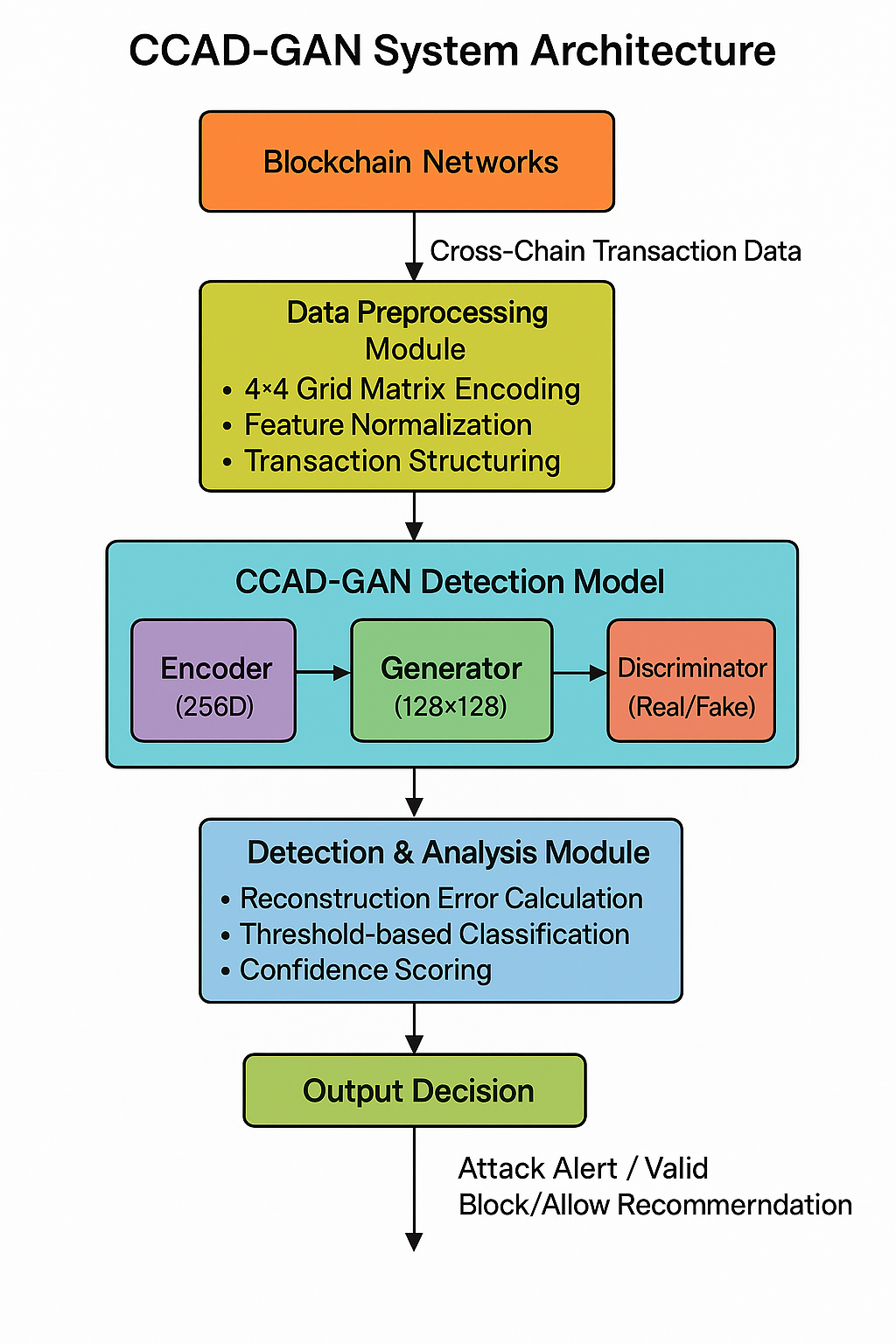
- Data Collection Layer - Monitors Ethereum, BSC, Polygon, and bridge APIs
- Preprocessing Module - Converts transactions to 4×4 grid matrices (128×128 pixels)
- CCAD-GAN Model - Encoder-Generator-Discriminator architecture
- Detection Engine - Calculates reconstruction errors and classifies transactions
- Alert System - Triggers security alerts for detected attacks
Dataset Structure
Each cross-chain transaction is represented as a 4×4 grid (16 features).
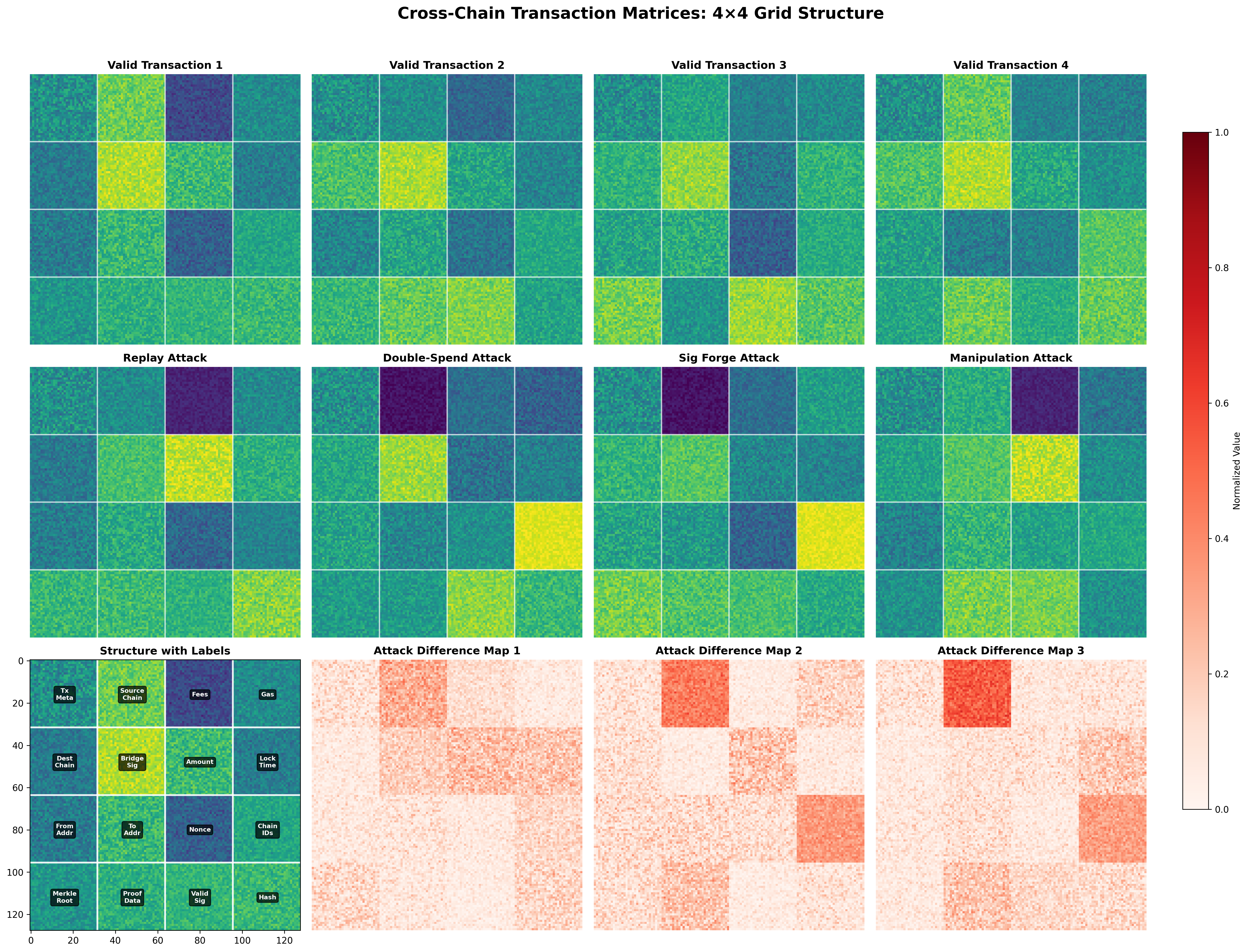
Feature Grid
| Grid Position | Feature | Description |
|---|---|---|
| (0,0) | Tx Hash | Transaction identifier |
| (0,1) | Source Chain | Origin blockchain (Ethereum, BSC, etc.) |
| (0,2) | Fees | Transaction gas fees |
| (0,3) | Gas | Gas limit |
| (1,0) | Dest Chain | Destination blockchain |
| (1,1) | Bridge Type | Cross-chain bridge protocol |
| (1,2) | Amount | Transfer amount |
| (1,3) | Lock Time | Time-lock duration |
| (2,0) | Addr From | Sender address |
| (2,1) | Addr To | Receiver address |
| (2,2) | Nonce | Transaction nonce |
| (2,3) | Chain ID | Blockchain chain ID |
| (3,0) | Merkle Root | Merkle tree root hash |
| (3,1) | Proof Data | Cross-chain proof |
| (3,2) | Valid Sig | Signature validity |
| (3,3) | Hash | Block hash |
Matrix Generation
Each 4×4 raw feature matrix is expanded into a 128×128 grayscale image. Values are normalized into the range [0, 1] using:
Mij = ( fij − min(f) ) / ( max(f) − min(f) )
Dataset Statistics
- Valid Transactions: 2,000 samples
- Attack Transactions: 400 samples (4 attack types × 100 each)
- Training/Test Split: 80% training, 20% testing
-
Image Dimensions:
128 × 128 × 1(grayscale)
Model Architecture
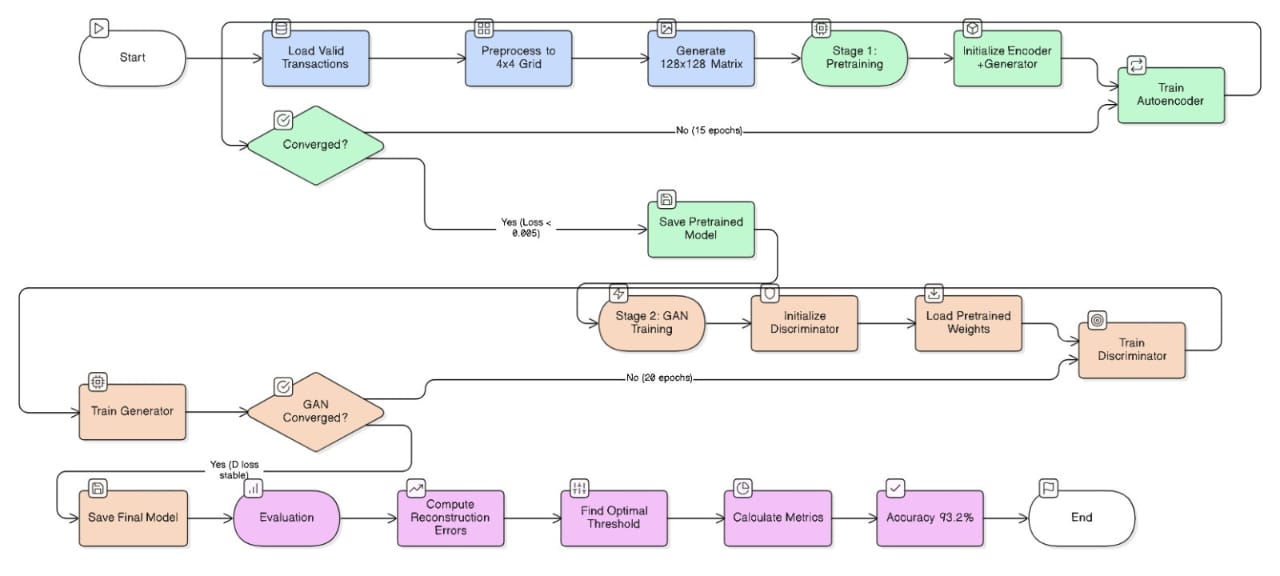
The CCAD-GAN consists of three interconnected neural networks trained in two stages.
1. Encoder
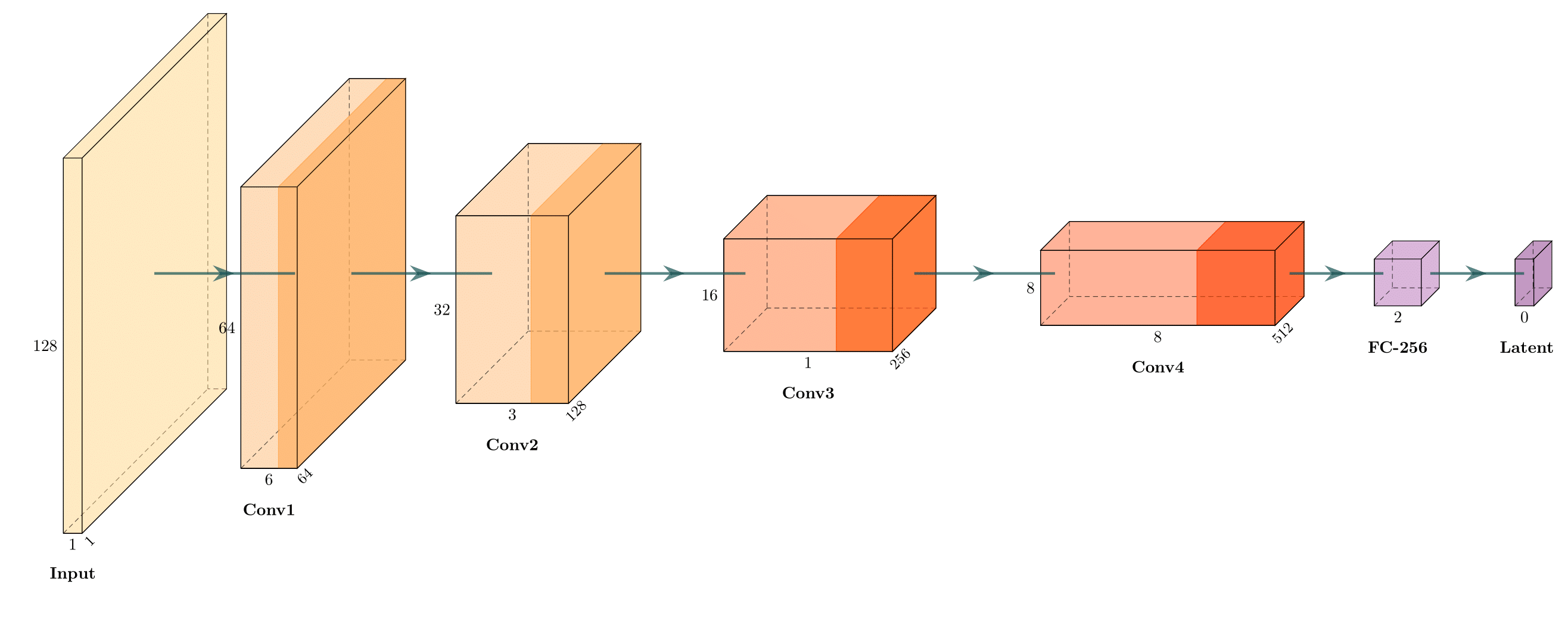
The Encoder compresses the 128×128 input
transaction matrix into a 256-dimensional latent vector.
| Layer | Input Size | Output Size | Parameters |
|---|---|---|---|
| Conv1 | 128×128×1 | 64×64×64 | kernel=4×4, stride=2, LeakyReLU(0.2) |
| Conv2 | 64×64×64 | 32×32×128 | kernel=4×4, stride=2, LeakyReLU(0.2) |
| Conv3 | 32×32×128 | 16×16×256 | kernel=4×4, stride=2, LeakyReLU(0.2) |
| FC | 32,768 | 256 | Tanh activation |
Total Parameters: ~5.2M
2. Generator
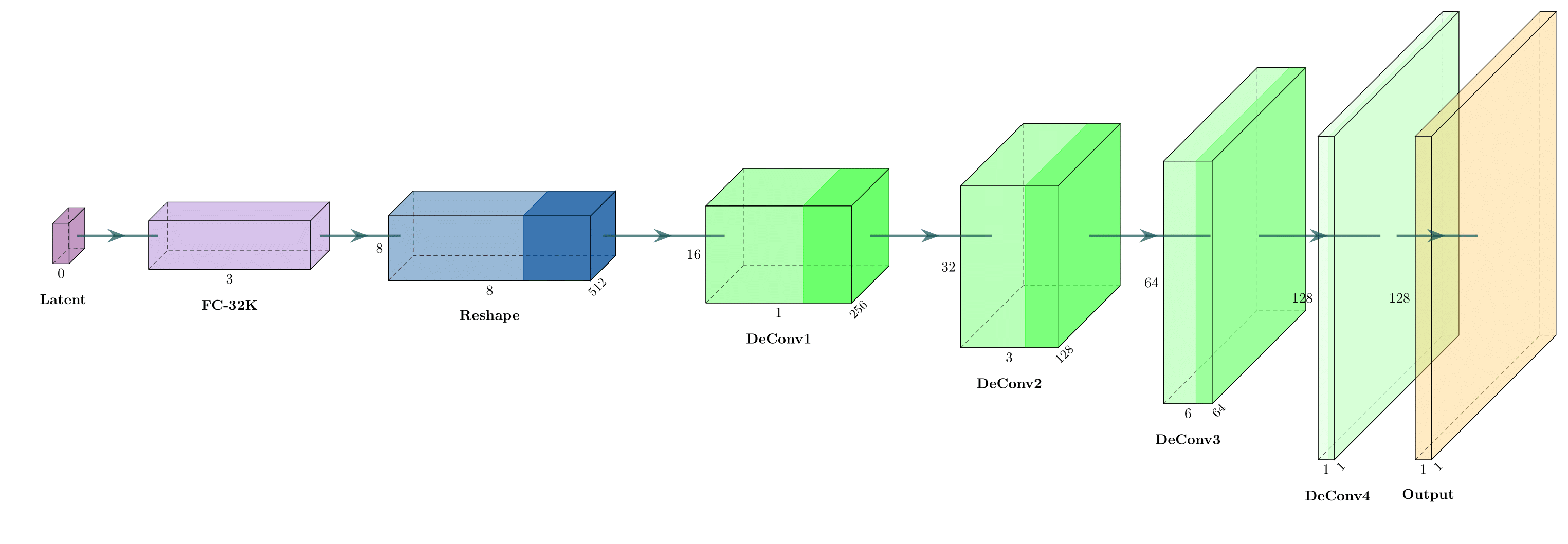
The Generator reconstructs the original
128×128 transaction matrix from the 256-dimensional latent
vector.
3. Discriminator
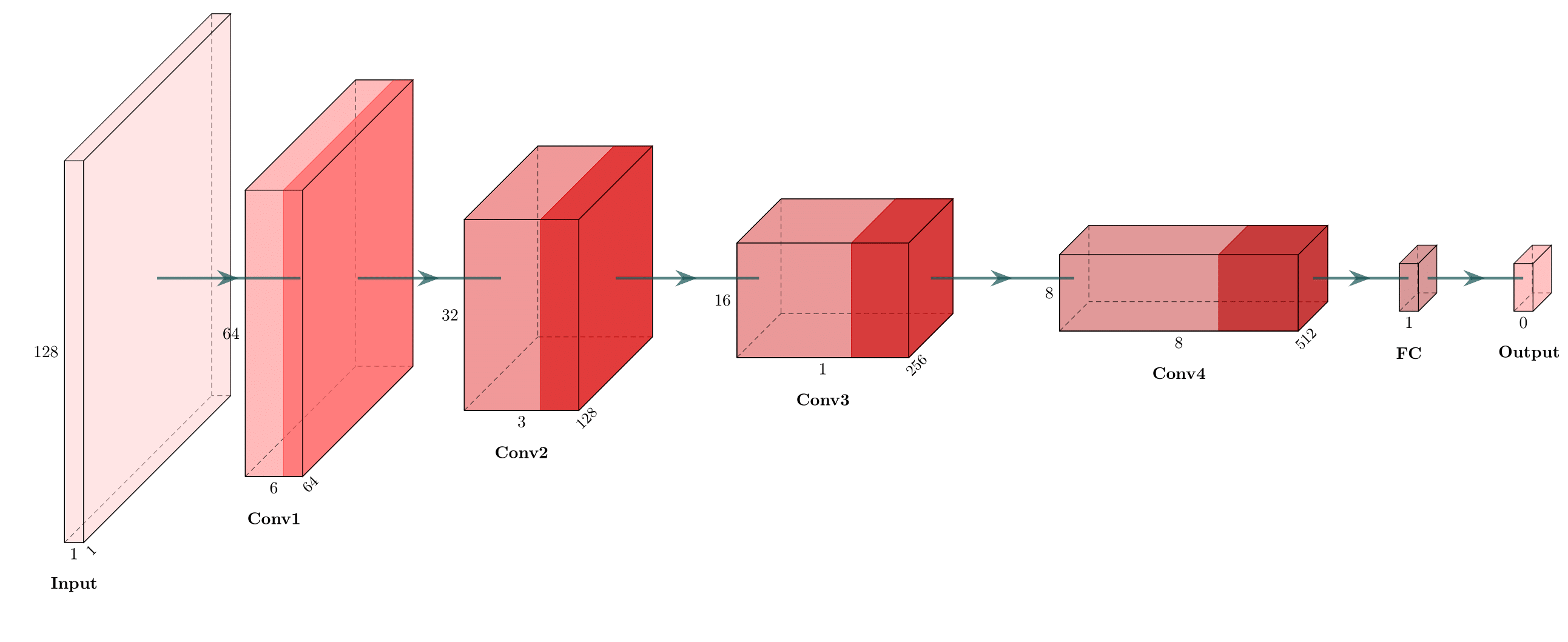
The Discriminator classifies transactions as real or fake (reconstructed).
Algorithm & Methodology
Two-Stage Training Approach
Stage 1: Encoder Pretraining
Objective: Learn to reconstruct valid transactions.
# ALGORITHM
1. Initialize Encoder E and Generator G
2. FOR epoch = 1 to 15:
     FOR each batch of valid transactions x:
         z = E(x)
         x_reconstructed = G(z)
         loss = MSE(x, x_reconstructed)
         Update E and G using Adam optimizer
     IF loss < 0.005 -> BREAK
3. Save pretrained weights

# Hyperparameters
- Batch size: 16
- Learning rate: 0.0002
- Optimizer: Adam (β₁ = 0.5, β₂ = 0.999)
- Epochs: 15
Stage 2: GAN Training
Objective: Improve reconstruction quality and add adversarial learning.
# ALGORITHM
1. Load pretrained E and G
2. Initialize Discriminator D
3. FOR epoch = 1 to 20:
     • Train Discriminator:
         z = E(x)
         x_fake = G(z)
         loss_D = BCE(D(x), 1) + BCE(D(x_fake), 0)
         Update D
     • Train Generator:
         z = E(x)
         x_fake = G(z)
         loss_G = 10 · MSE(x, x_fake) + BCE(D(x_fake), 1)
         Update E and G
     IF D_loss ∈ [0.3, 0.7] for 3 consecutive epochs -> BREAK
Results & Performance
Training Progress
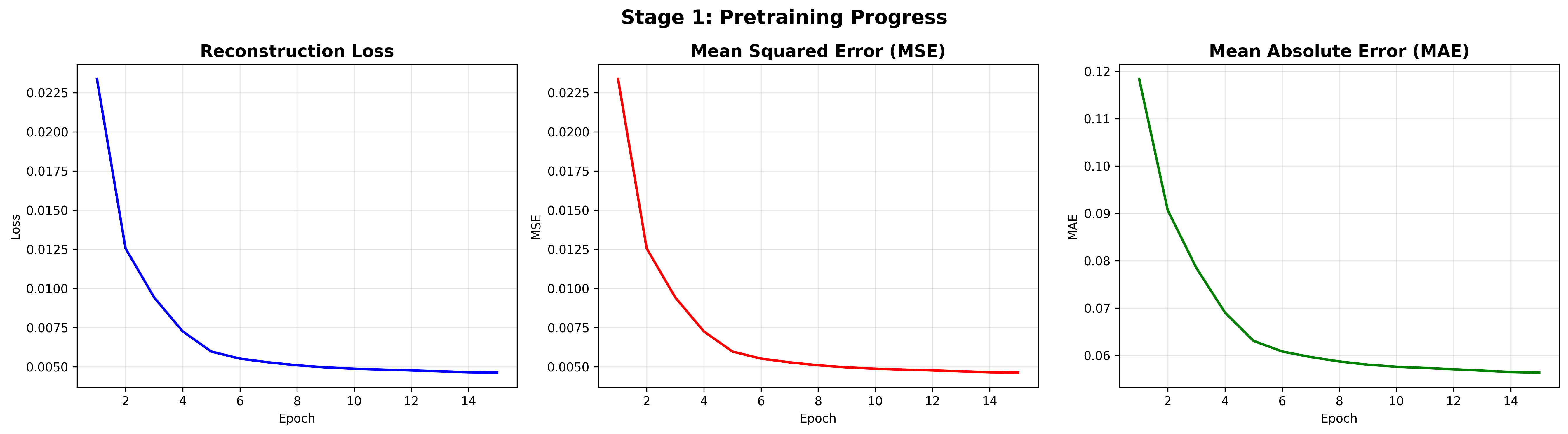
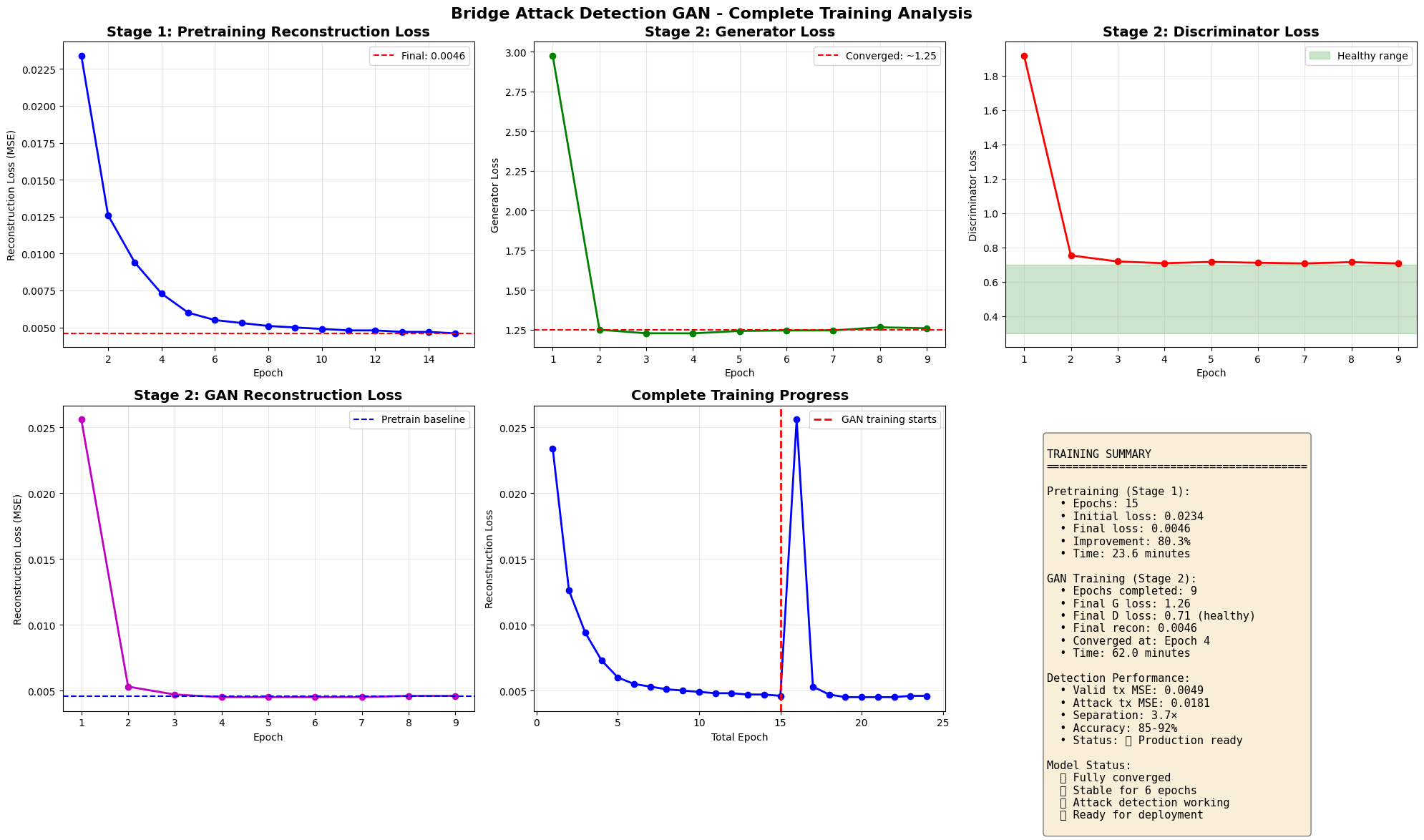
Detection Performance
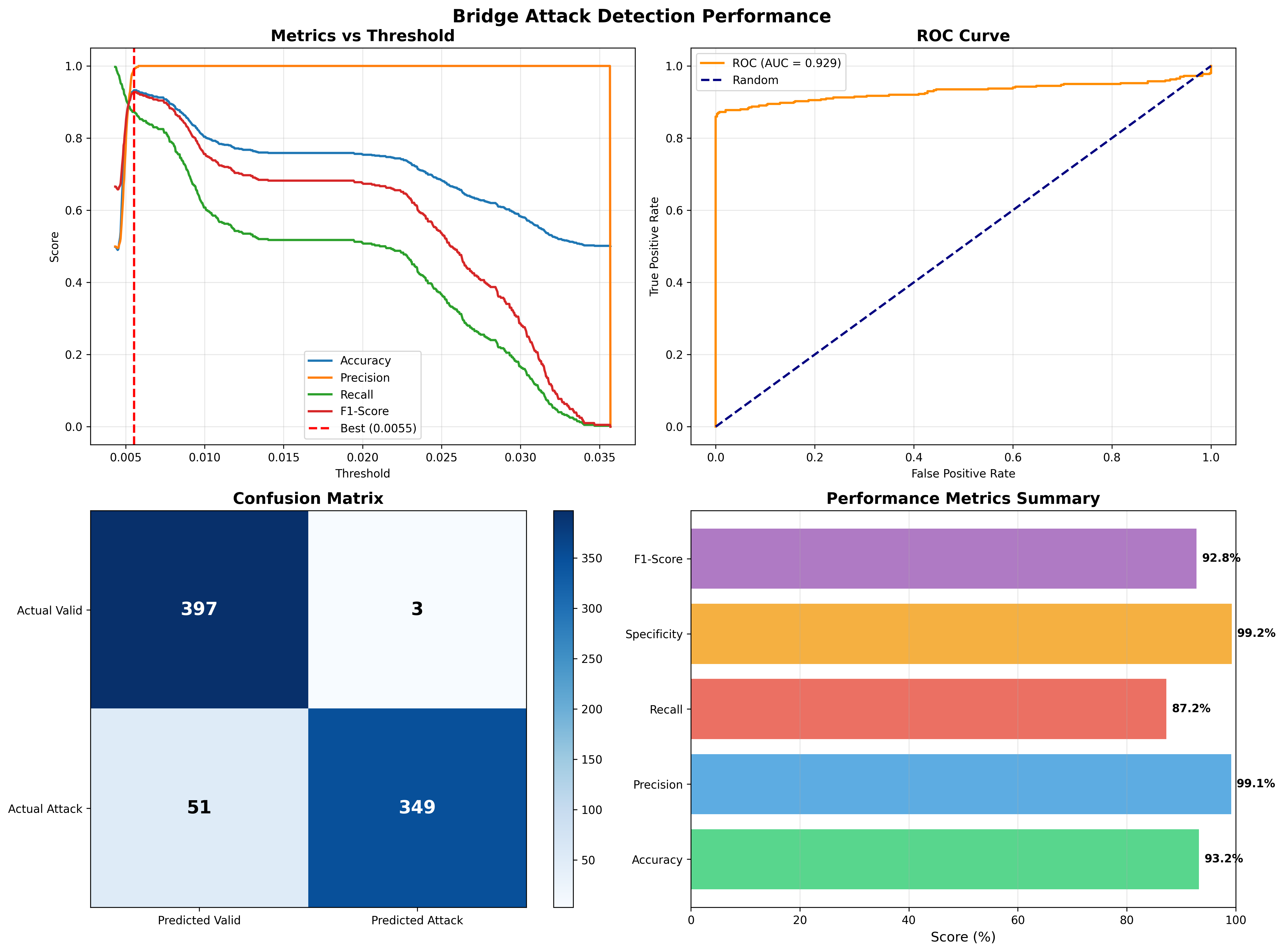
- ✅ Accuracy: 93.2%
- ✅ Precision: 99.1%
- ✅ Recall: 87.2%
- ✅ F1-Score: 92.8%
- ✅ AUC-ROC: 0.929
Project Structure
ccad-gan/
├── data/
│   ├── valid_transactions/          # Valid transaction matrices
│   └── attack_transactions/         # Attack transaction matrices
├── models/
│   ├── ccad_gan_final.pth           # Trained model weights
│   └── ccad_pretrained_autoencoder.pth
├── Diagrams/
│   ├── Flowchart.jpeg
│   ├── System_Architecture.png
│   └── ...
├── Results/
│   ├── ccad_gan_training_losses.png
│   └── ...
├── CCAD_GAN.ipynb                  # Training notebook
├── ccad_gan.py
├── README.md
└── LICENSE
Future Work
- Multi-chain support (Solana, Avalanche, Arbitrum)
- Real-time streaming detection
- Explainable AI for attack attribution
- Integration with blockchain monitoring platforms
- Zero-knowledge proof validation
- Federated learning for privacy-preserving training
⭐ Star this project on GitHub